Norse tattoo ideas and designs
I've put together Norse-themed tattoo ideas: gods, warriors, runes and signs. Below the gallery I explain what's actually confirmed, what's myth, and which style to choose.
What Viking tattoos actually mean: gods, animals and signs
Norse tattoos draw on Viking mythology — gods, the animals that travel with them, and a handful of signs whose meaning was never actually proven. Most of what we know about these myths comes from Iceland's Poetic Edda and Prose Edda, written down in the 13th century, two hundred years after the Viking age itself had ended.
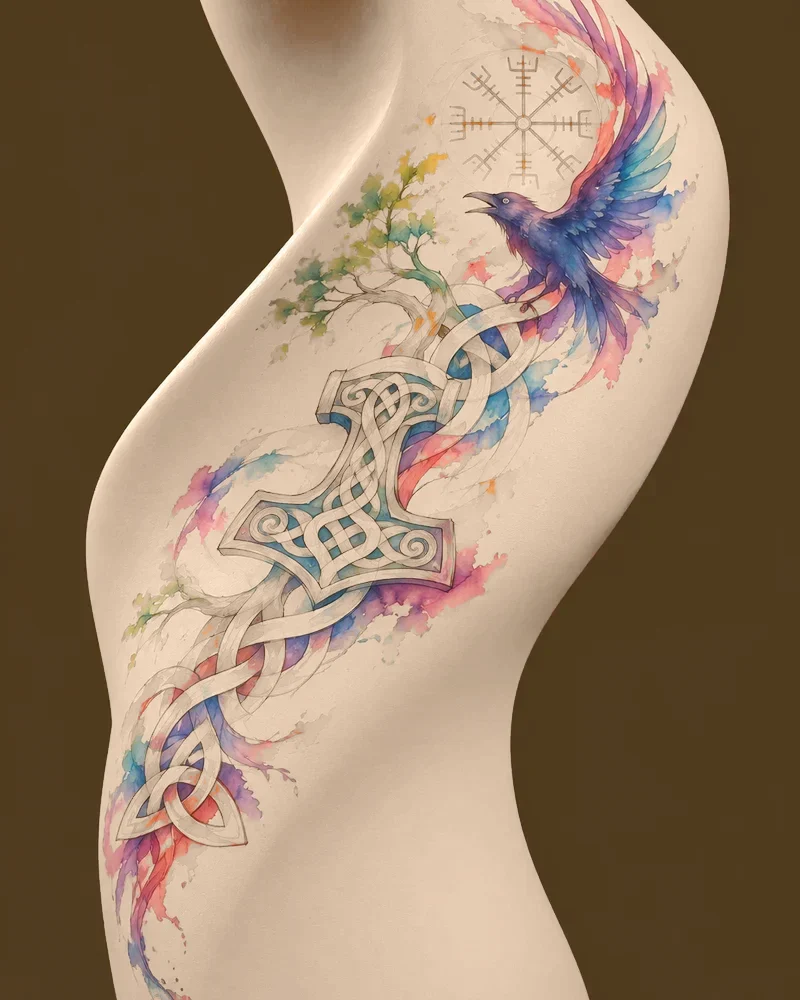
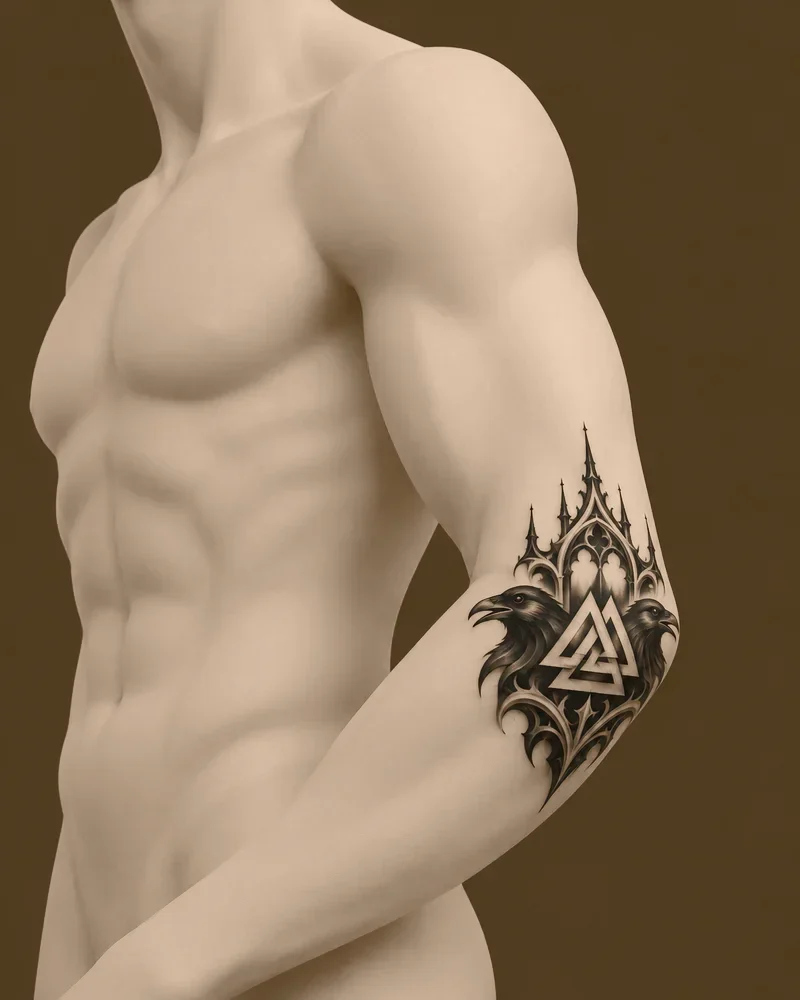
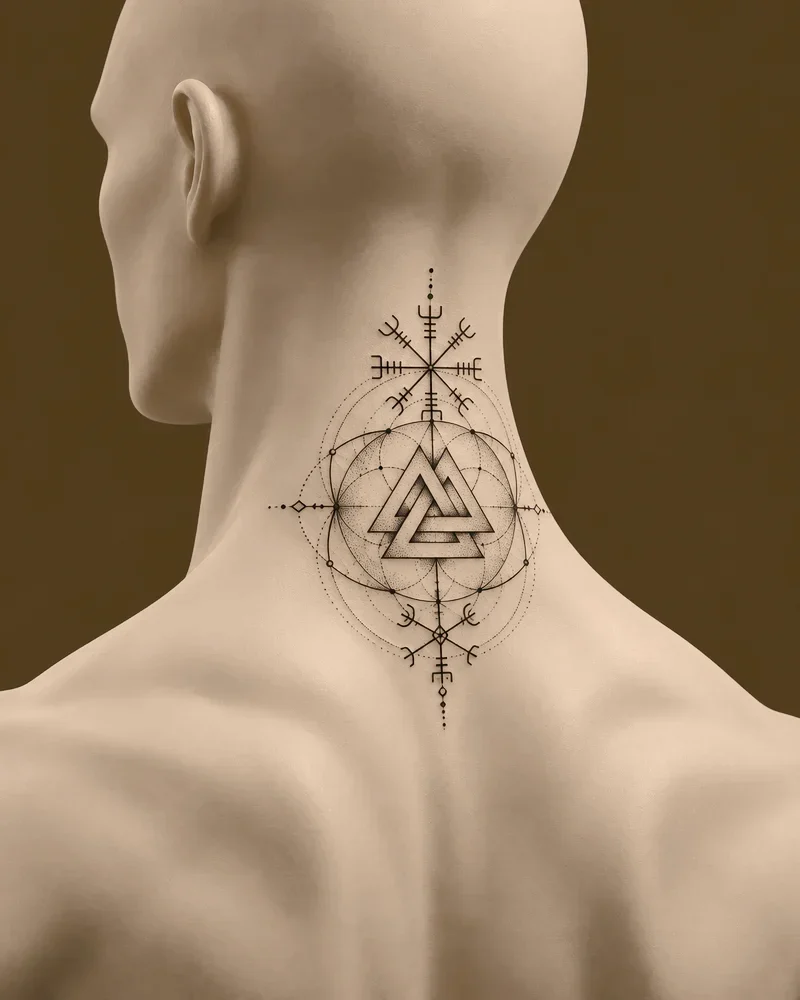
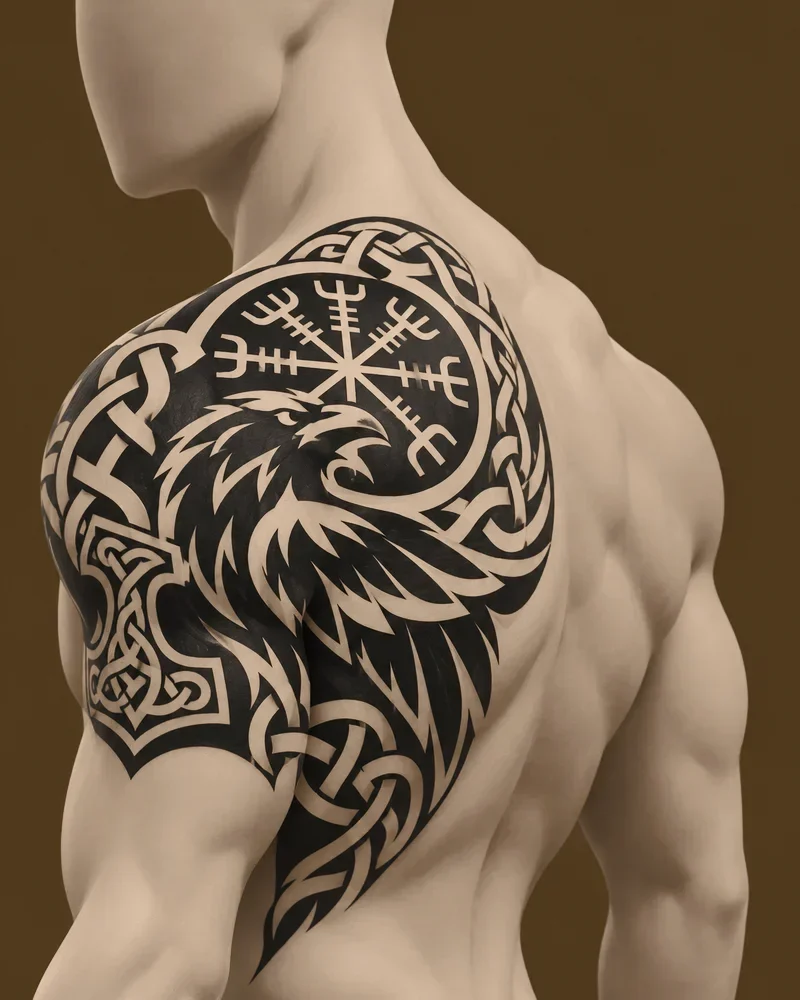
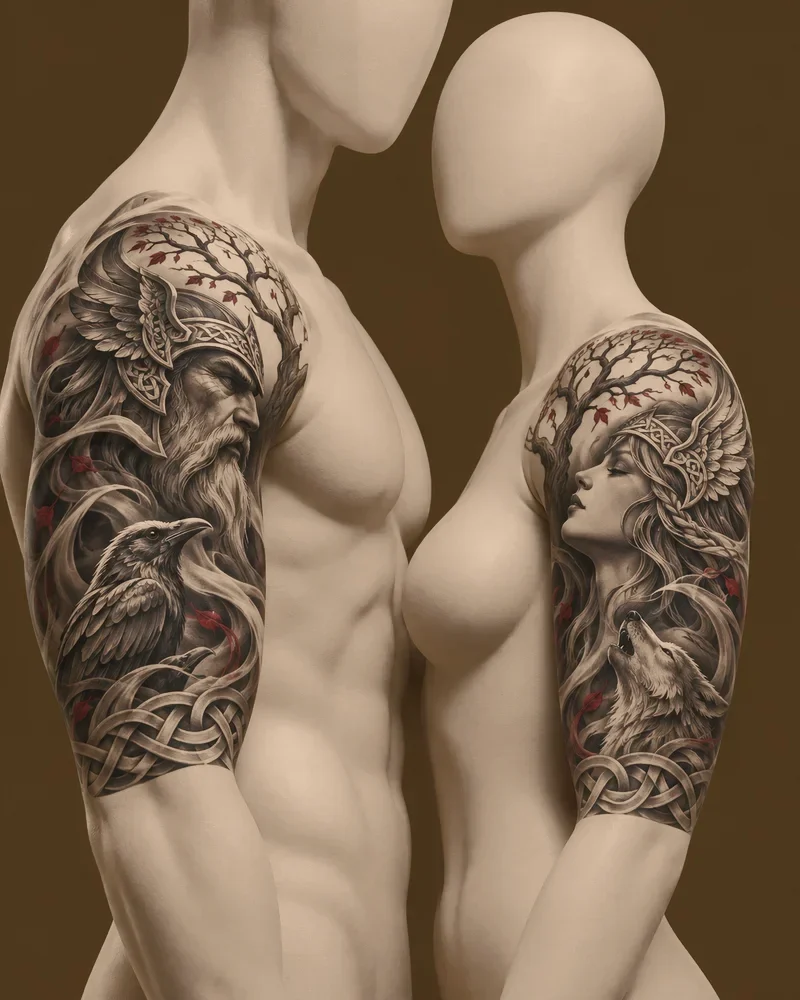
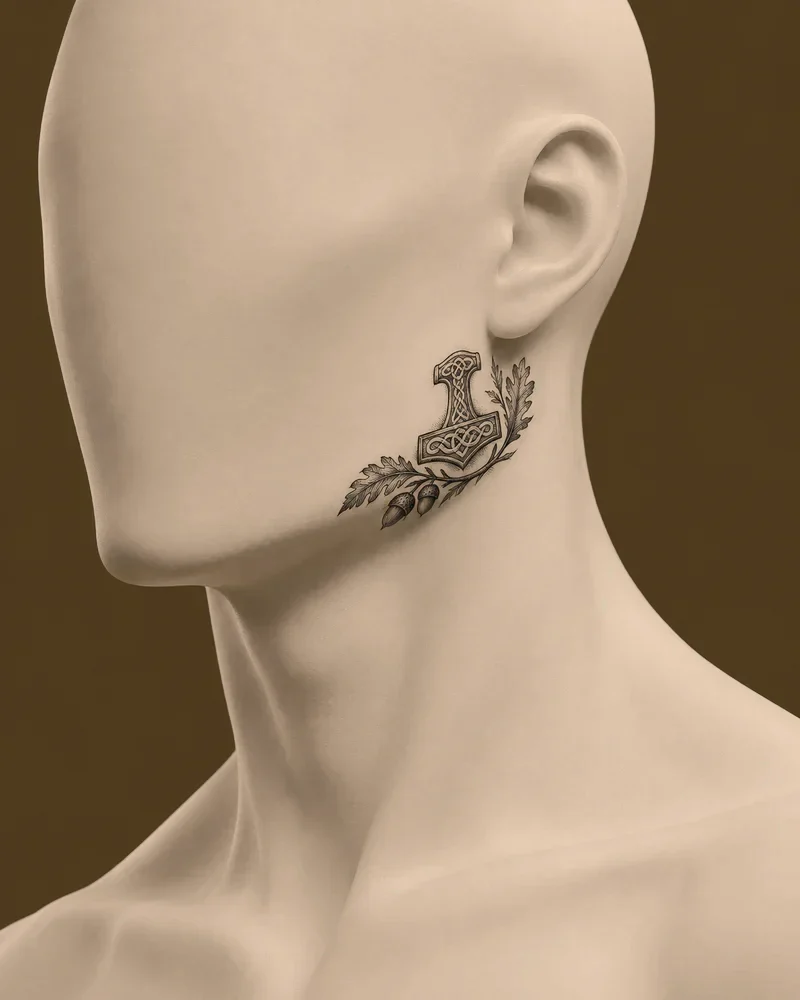
The most common image is Thor's hammer, Mjölnir. In the Viking age people wore it as a protective pendant, and it's still read as a symbol of strength today — though that's more a modern take than anything written down at the time. The valknut, three interlocking triangles, is tied to Odin and a warrior's death in battle, but scholars still haven't agreed on what it actually means. For the Norse, the wolf Fenrir stood for destruction and the end of the world: the myth has him killing Odin on the day of Ragnarök, while Odin's own ravens, Huginn and Muninn, perched on his shoulders, stood for thought and memory.
- OdinThe chief god, wisdom and war; the myth has him hanging from the tree Yggdrasil for nine nights to learn the runes
- Mjölnir, Thor's hammerProtection and strength; a protective pendant in the Viking age, though today's reading is largely modern
- ValknutA sign linked to Odin and a warrior's death in battle; its exact meaning was never settled
- Huginn and Muninn, Odin's ravensThought and memory — the two companions who bring the god news from across the world
- Fenrir, the wolfDestruction and the fate of the world: the myth has him killing Odin on the day of Ragnarök
- Yggdrasil, the treeThe ash tree that connects the nine worlds of Norse mythology
Runes and the “Norse compass”: what's confirmed and what's myth
Runes really are a Norse alphabet — just not a single one. The Elder Futhark, 24 signs, came first; by the Viking age itself, people had moved on to the Younger Futhark of 16 runes. For the full rundown of the runes and what they mean, see the rune tattoo page.
Before you get a runic inscription or a combination of signs tattooed, check its meaning against more than one source: some runes and combinations have been adopted by extremist movements today, and it's worth knowing that in advance — see the guide to symbols and context.
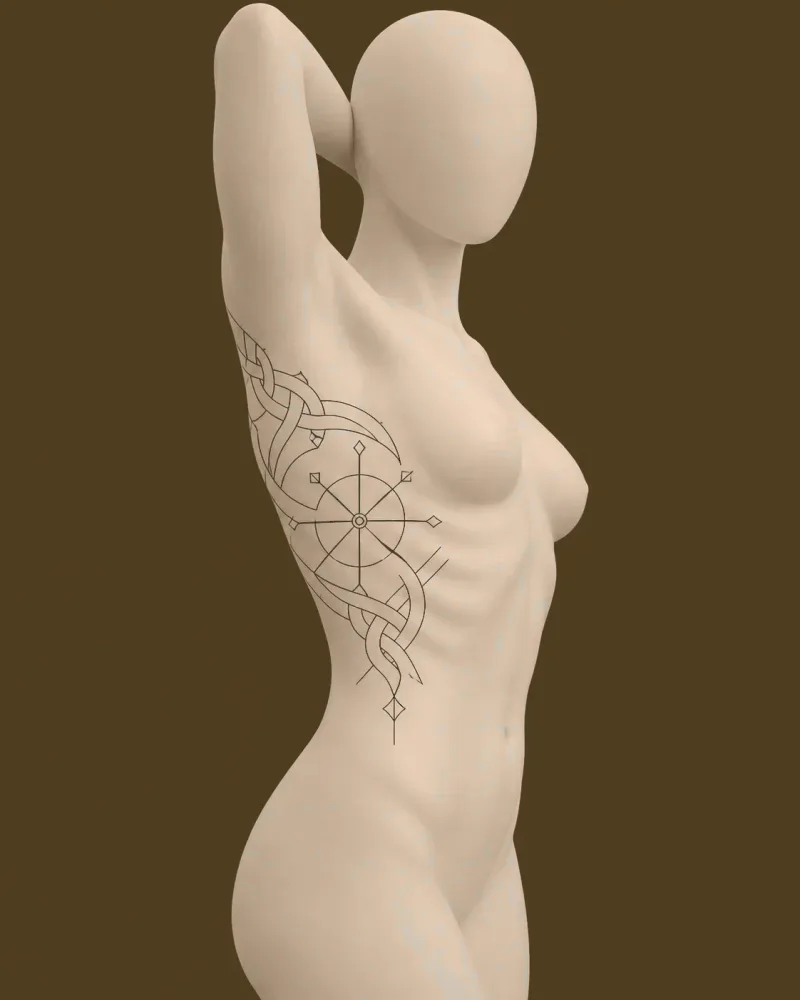
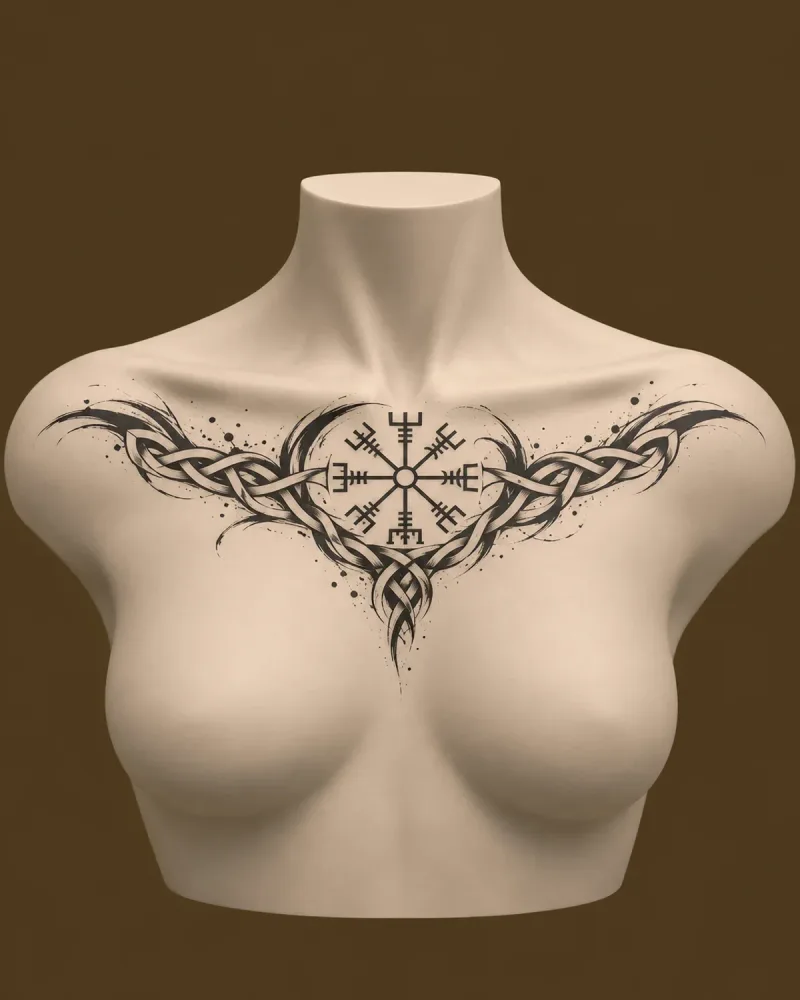
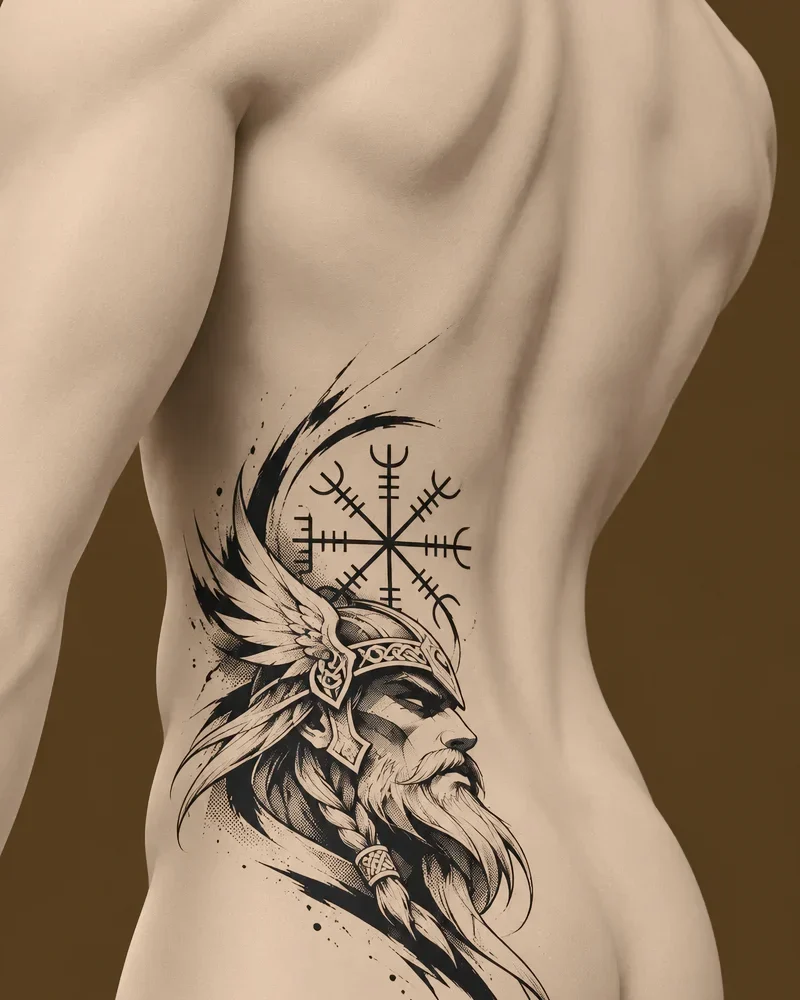
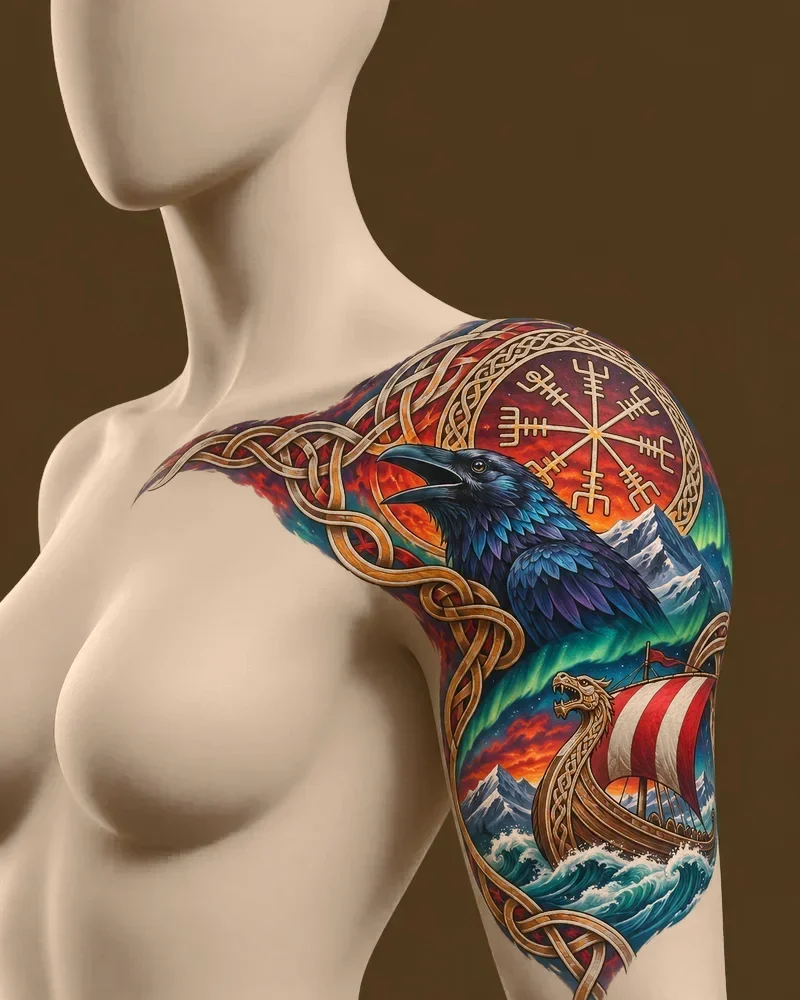
What gets sold as a “Norse compass” is actually the vegvísir, first written down in an Icelandic manuscript from 1860 — centuries after the Viking age ended. It's a genuine Icelandic sign, not something invented out of nowhere, but it isn't a Viking-age artefact either. The compass tattoo page goes through other compass designs in more depth.
- Younger Futhark runesThe real alphabet of the Viking age itself, 16 signs
- Elder Futhark runesAn earlier Germanic alphabet of 24 signs, used before the Viking age
- “Norse compass” (vegvísir)An Icelandic sign from an 1860 manuscript, not a Viking-age find

If you want an inscription in runes, we'll first decide which futhark to write it in: that changes both how it looks and what it means.
Where people get Norse tattoos
A big composition (a warrior, a god or a wolf) usually becomes a sleeve, one large piece covering the whole arm: down the forearm and over the shoulder, sometimes as one continuous forearm-and-shoulder piece. Round, symmetrical signs like the valknut or the compass sit well on the shoulder, back or chest.
A small sign or a single rune fits on the hand or wrist, though the lines there blur faster than elsewhere, because skin in those spots renews itself quicker. A longer scene or a runic inscription works well running down the calf or leg, and people pick the neck less often — it's one of the more sensitive spots.
Which styles suit Norse tattoos
I do these subjects in graphic style, minimalism and blackwork — the detail in a warrior or an ornament stays crisp, and a solid fill in a valknut or a compass holds up longer than a thin outline does. Fine line suits a rune or a small sign with no extra lines.
I don't do realism. A warrior or a god I'll draw in graphic style or blackwork: the line gives it character, and the piece reads from across the room.
- GraphicA warrior or god with hatching, like a book illustration
- BlackworkA solid fill for the valknut or an ornament, holds up longer
- MinimalismA rune or sign with no extra lines
- Fine lineA thin outline for a short runic inscription
- GeometricOrnament and interlacing built from simple shapes
- RealismNot something I do — I'll draw the warrior or god in graphic style instead
Norse tattoos for men, for women and for couples
A big warrior, god or wolf is usually requested by men, and a rune or a small sign by men and women alike, though there's no hard rule: the valknut and the compass suit any request.
For a couple, two halves of one sign work nicely — a valknut split between you, say, or a shared symbol placed in different spots. For more ideas for two, see the couples tattoo page.
Where to find Norse tattoo design ideas besides Pinterest
Look beyond tattoo galleries: runestones, book illustrations of the sagas and museum archives of Norse mythology are all worth a look.
If a runestone or a saga engraving catches your eye, send me a couple of examples: I'll take the way the lines interlace and draw the design again for your arm.
AI is good at churning out options: in a couple of minutes you'll see different gods, signs and ornaments and work out which one feels right. ChatGPT, Gemini and Ideogram are free to try; Midjourney is paid. Send me the one you like and I'll draw the design myself.
Ready-to-use prompt
Instead of Pinterest
- Wikimedia Commons: Vikings in art
The Vikings in art category — warriors, ships and scenes from the sagas in paintings and engravings. Free to browse and download.
- Wikimedia Commons: Norse mythology
The Norse mythology category — illustrations of gods and scenes from the myths. Free.
Books, museums, archives
- Wikimedia Commons: Runestones
The Runestones category — carved runestones from the Viking age. A good base for a runic ornament.
Norse tattoo FAQs
Can't find your question? Message me on Telegram or Instagram. I reply personally.
Did the Vikings themselves actually get tattoos?
The only written account comes from the Arab traveller Ahmad ibn Fadlan, who in the 10th century described the Rus' with dark green tattoos running from their fingertips to their neck, in the shape of trees and other figures. No direct archaeological finds from that period survive, so the actual designs can't be reconstructed.
What are Viking tattoos called?
Viking tattoos, Norse tattoos, Nordic tattoos — they're all names for the same theme: images drawn from Viking-age mythology and everyday life. There's no single term that covers the whole group, so it's easier to just name the actual image — Mjölnir, the valknut, a rune.
What's the difference between the Norse triangle and the Norse circle in a tattoo?
The triangle design is usually the valknut: it turns up on runestones and among finds from the Oseberg burial, so it really does date back to the Viking age. The circle is the vegvísir, sold as a “Norse compass” — it's only known from a 19th-century Icelandic manuscript, much later than the Viking age. Both come up in requests, but only the triangle is backed by history.
Does the meaning of Viking tattoos differ for men and women?
No — the symbols don't carry a separate meaning for either: the valknut, Mjölnir or the wolf mean the same thing whoever wears them. What usually differs is the choice of subject and size, covered in the section above.
About
Hi, I'm Olya.
I've been tattooing for over 7 years and work in almost every style: graphic, minimalist, anime and more. I also do gold tattoos, which are my signature style. You can see examples in the portfolio.
I want your tattoo to make you happy for years to come. That's why we talk through the idea, placement and size in detail — and then I draw a design just for you, rather than simply copying a reference.
I work in a lovely studio in Belgrade. During the session there's always tea or coffee and something sweet, and you can put on your favourite music or a film. We can chat or just sit quietly, whatever you prefer.
After the session you'll get aftercare instructions, and I'll stay in touch until your tattoo is fully healed. Feel free to ask me anything, any time
My socials
No pieces in this category yet.