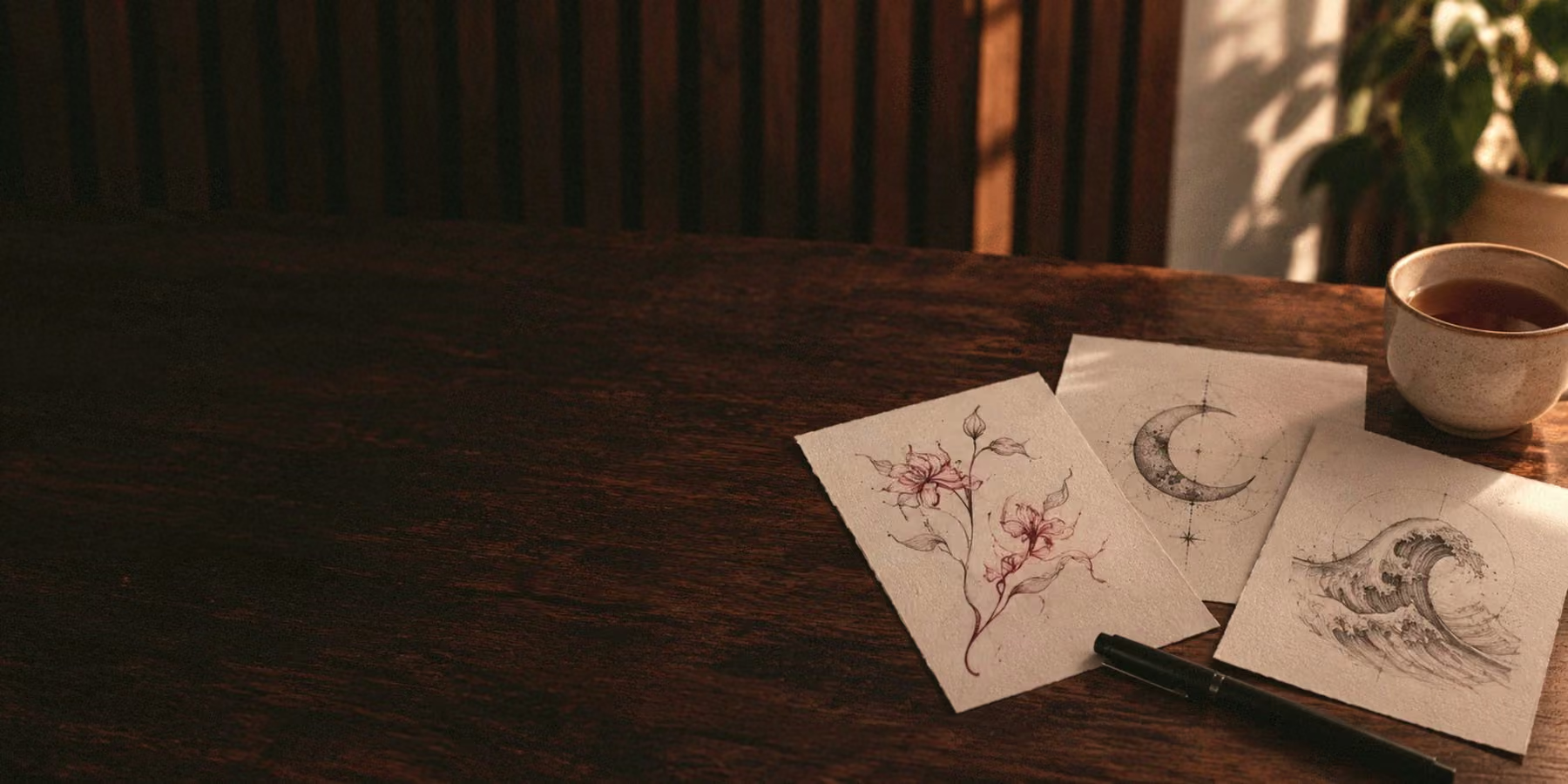

Here are the terms that come up most often in messages with an artist and in this guide. They’re grouped by topic: tools, design, the session, healing and how tattoos change over time. If you can’t find a word here, ask your artist. It’s normal to ask, and explaining the terms is part of a consultation.
Tools and materials
These are the words you’ll hear most when the artist is setting up their workstation before a session.
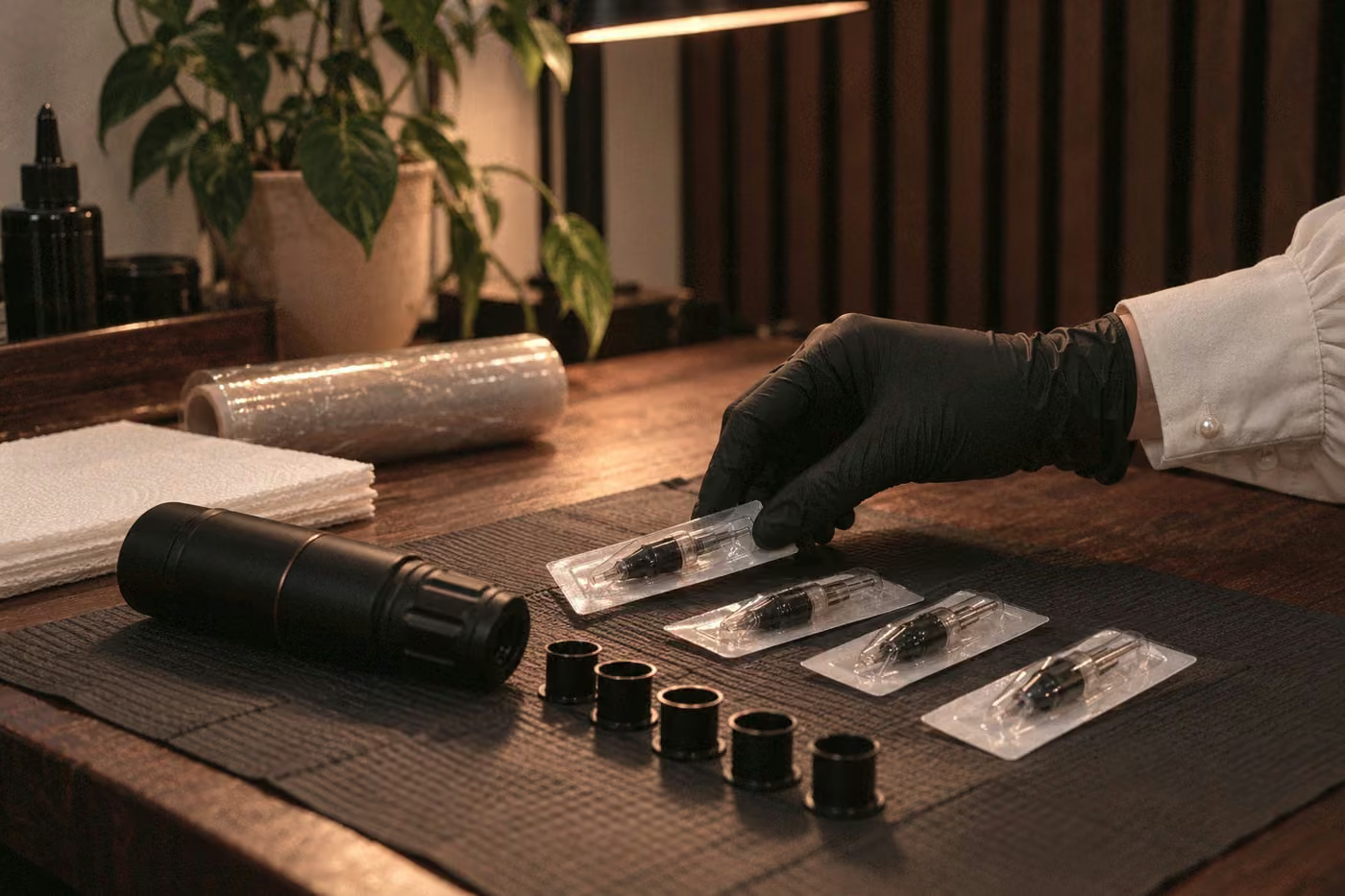
- Tattoo machine. A tool that moves the needle up and down at high speed. There are rotary and coil machines.
- Cartridge. A disposable needle module that clicks into the machine. It’s opened in front of you.
- Needle configuration. The number of needles in a group and how they’re arranged. This determines the type of line or shading you get.
- Liner. Needles grouped in a round bundle, for outlines and lines.
- Shader and magnum. Needles in one row or two, for shading and fill.
- Pigment. The colour that goes into the skin, often called tattoo ink. Not to be confused with ink for writing.
- Stencil. An outline of the design transferred onto the skin for the artist to follow.
- Healing film. A clear second-skin film stuck over a fresh tattoo for the first few days.
Design and technique
- Outline. The lines that define the shape of the design.
- Packing, or fill. Filling an area solidly with pigment.
- Shading and blending. A smooth transition from dark to light.
- Hatching. Depth created with short, parallel lines, as in an engraving. Linework and hatching are the basis of graphic tattoos.
- Negative space. Untattooed skin that becomes part of the design itself.
- Flash. A ready-made design by the artist that you can pick and get tattooed as it is.
- Custom design. A design drawn for you, based on your idea and chosen placement.
You’ll find style names such as dotwork, blackwork and old school in the separate “Tattoo style directory”.
When something has gone wrong
These words come in handy if you’re taking a critical look at someone else’s work or at an old tattoo of your own.
- Blowout, or “bleeding”. The pigment has gone too deep and spread under the skin: the line looks fuzzy, with a bluish halo.
- Overworking. Going in too deep or over the same spot too many times. This causes more damage to the skin, so it takes longer to heal.
- Underworking. Pigment placed too close to the surface, so some is lost during healing.
- Holidays, or gaps. Light patches in a line or fill after healing. Usually fixed with a touch-up.
If you see light patches after healing, don’t panic: everyone’s skin heals in its own way, and it isn’t always the artist’s mistake. Send me a photo in daylight — that makes it easier to tell whether you need a touch-up.
Booking and the session
- Consultation. A conversation about the idea, placement, size and price before you book.
- Deposit. An advance payment that forms part of the price and secures your booking. The rules are in “Deposit and booking rules”.
- Design. The drawing of your tattoo that you agree on with the artist before the session.
- Transfer. Putting the design onto the skin using a stencil.
- Session. The time spent working on the tattoo. Large pieces take several sessions.
- Sleeve. A tattoo that covers the arm from shoulder to wrist, or part of it.
Aftercare and healing
- Plasma. A clear or slightly tinted fluid that seeps out in the first few hours. This is normal.
- Scabs. A thin layer of dried plasma and pigment. Don’t pick them off.
- Peeling. The skin flakes off as it does after sunburn, usually in the second week.
- Cloudy stage. After peeling, the design looks dull, as if under a milky film. It passes on its own.
- Healing. The time it takes for the skin to recover fully: two to three weeks on the surface, longer underneath.
What’s normal and what isn’t is covered in “Tattoo healing timeline” and “Normal or a warning sign”.
The life of a tattoo
- Touch-up. Refreshing the lines and tone after healing. More in “Tattoo touch-ups”.
- Cover-up. A new design over an old one. More in “Covering up an old tattoo”.
- Lightening. A few laser sessions to fade old work before a cover-up.
- Laser removal. Breaking down the pigment with a laser over several sessions. More in “Tattoo removal”.
- Fading. A design gradually becoming paler over the years, especially with sun exposure.
Frequently asked questions
Can't find your question? Message me on Telegram or Instagram. I reply personally.
How is pigment different from ordinary ink?
Pigment is made specifically for skin: it’s sterile and tested for safety. Ink for pens and printers isn’t suitable.
What does it mean when a tattoo has “blown out”?
The pigment has spread under the skin and the lines have gone blurry. Usually, this means the ink was placed too deep; sometimes it happens because of how the skin behaves in areas that bend.
Is flash cheaper than a custom design?
Often, yes: the design is already drawn, so no time goes into creating it. But it all depends on the artist.
What is the “cloudy stage”, and how long does it last?
It’s the period after peeling when the design looks dull. It usually passes within one to two weeks.